Thursday, July 9, 2015

HEART PUZZLE

HEART PUZZLE
I apologize for taking so long to provide info on how to administer this activity.  Hopefully my brilliant readers have found this self-explanatory, but even the best of minds need a little assistance at times...So here it is!!

HEART MAPS/PUZZLE/ WHATEVER YOU DECIDE TO NAME IT...is a fun creative way for a person to identify and explore things they hold true to them.  It can be a representation on their inner most thoughts and feelings.  It can be completed in different ways.  You decide what prompts.  I choose different prompts for different clients depending on age, intelligence, maturity, the goal/objective we are working toward in that particular session, 

Okay, so this activity is quite simple.

1. First you draw a large heart.  I strongly suggest you, the adult, draw the heart outline otherwise you may go through 10 pieces of paper.  In my experience children tend to struggle with the concept of "LARGE".  Be sure the heart is large enough to fit writing.  The younger the child, the larger the writing may be. 

2. Next you draw squiggly lines throughout the heart to give the illusion of a PUZZLE. 

3.  Next you provide the prompt. Think about what you are working toward with the individual. And ask them to write down your list of prompts somewhere near the outside of the heart.  Basically they are making a “map key.”  I strongly suggest you give 3….maybe 4…prompts. You want the participant to be able to list more than one thing for each topic/prompt. (see photo)
Examples…
SELF ESTEEM= I AM GOOD AT/ I CAN WORK TOWARDS/ MY ACCOMPLISMENTS
FAMILY THERAPY= I LOVE/ I TRUST/ I CAN RELY ON/I WISH I KNEW BETTER
GETTING TO KNOW ME= I LIKE/I HATE/I AM GOOD AT/MY DREAMS/ MY FEARS

4. Now, ask them to assign a color to each.  In my example above I have things I do not like represented with the color red because in real life I cannot stand the color read.  Things I want are represented with green because it is my favorite color.  I decided to get creative after doing these over and over.  I made each prompt layered.  Feelings I enjoy are in light green and if I wish to experience them more I surrounded the light green with darker green.   You can choose to allow the person to be creative and do their own thing or be more directed and insist they choose 1 color per prompt.

5. Finally, process and discuss. You can also allow the participant to make a heart depicted what they wish their heart puzzle/map will look like once they have completed treatment. Or what they are hoping their heart will look one day if you are not using this for counseling/therapy.

SUMMARY
1.        LARGE HEART
2.      SQUIGGLY LINES
3.      LIST OF PROMPTS
4.      COLORS
5.       PROCESS/DISCUSS

Thanks for stopping by!!

AYLA 


MEET YOUR EMOTIONS: CREATIVE WAY TO USE THE EMOTIONS FROM DISNEY PIXAR'S "INSIDE OUT" AS AN INTERVENTION.

MEET YOUR EMOTIONS!!

 HI!

    How amazing would it be for us as professionals (and even parents) to be able to have relevant and age appropriate videos that teach about emotions to present to our children or clients??  Well our wishes have been granted! Disney's Pixar has a genius working amongst them who heard our prayers!!   So I have put together a list of the videos from "Inside Out" that allows us to meet each emotion.

What you will find.
  • The movie addresses our core emotions: FEAR, JOY, ANGER, SADNESS & DISGUST
  • Each video names the emotion and provides a snippet of that emotion exhibiting the body language, sounds, and verbal language that coincides with each emotion. 
  • Each video also provides a snippet of what the main character, Riley, is going through to trigger that emotion.

HOW TO USE:
     Show each video (one at a time) to your client/child.  Ask them what they remember from each clip. Then ask them to describe a time they felt that emotion.  BONUS: Have the child/client draw or paint the time they felt that emotion.  For negative emotions you may wish to have them draw a coping skill to help them manage that emotion.  Or have them role play how they would use their coping skills to manage those emotions.

Enjoy!


   LET ME INTRODUCE YOU TO FEAR


 LET ME INTRODUCE YOU TO JOY!


LET ME INTRODUCE YOU TO ANGER


LET ME INTRODUCE YOU TO SADNESS


LET ME INTRODUCE YOU TO DISGUST


Live it up,
Ayla
p.s.  **Disclaimer** I do not own the rights to this movie or each clip.  These clips were obtained from www.youtube.com.

Wednesday, June 10, 2015

VIDEO: BUILDING UP YOUR PERSONAL ARTS & CRAFTS COLLECTION FOR SIMPLE INTERVENTION ACTIVITIES

 
HI!
CHECK OUT MY VIDEO ABOUT CREATIVE INTERVENTIONS USING PAPER, STICKERS, AND VARIOUS OTHER ITEMS. THIS IS A GREAT WAY TO START BUILDING UP A COLLECTION OF WHAT YOU NEED TO START A MORE CREATIVE METHOD OF APPROACHING COUNSELING/THERAPY!

KIDS LOVE TO BE HANDS ON AND BE ABLE TO HOLD SOMETHING THEY CREATED IN THIER OWN 2 LITTLE HANDS.  WHY NOT INCORPORATE A NEW CREATIVE WAY OF COMMUNICATING TO YOUR PRACTICE??!!

YOU CAN VIEW THIS VIDEO BY CLICKING THE ACTUAL VIDEO BELOW.

 
YOU CAN ALSO VIEW OR SHARE MY VIDEO BY  CLICKING THE GREEN LINK BELOW.

CREATIVE INTERVENTIONS:  http://youtu.be/REh1UORKaYw

THANK YOU.
 #SHARINGISCARING


LOVE YOU TO PIECES
AYLA

I AM GRATEFUL FOR: Positive Thinking & Self Exploration Art Activity


Excuse the quality of this photo.  This activity allows for the participant to engage in identifying the things they can be grateful and thankful for.  It encourages positive self esteem, self image, gratitude, positive thinking, and humbleness.  (is that a word??)

1st: You can start the activity off for the participant by drawing a circle in the middle of the page and writing "I am grateful/thankful for..."

2nd: You can write down the topics (as identified by the participant) as though you are creating a start or flower petals out of words.  (refer to picture)  If they are unable to come up with enough things they are grateful for you may wish to provide examples.

If you end up providing examples keep in mind what the 
participant identified on their own vs your suggestions. 

**SOCIAL WORKERS/COUNSELORS:: And inability to identify positive things in life or things to be grateful for is something you may want to explore further if you are providing mental health services.
**PARENTS: If you are a parent you may wish to consult your child's PCP or mental health professional.

Topics may include but are not limited to:
STRENGTHS
MIND AND BODY
THIS MOMENT
LIFE
ANIMALS
LOVE AND PASSION
CREATIVITY
FRIENDSHIPS 
MEMORIES

TREE OF LIFE: Art activity for coping, self exploration, rapport, etc

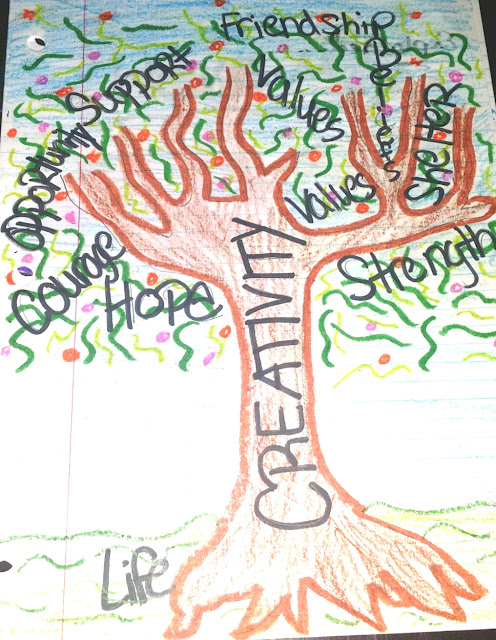
TREE OF LIFE art activity                     
coping skills, self exploration, identity


In this activity you and your client can draw a tree.  You want to attempt a tree with a large and wide trunk with thick branches to be able to write inside. (if necessary draw or find a picture of a blank tree and make black and white copies, then allow the client to just color it.)  The roots represent what the client feels his or her roots come from or what they feel rooted in.  (ex: I put life because I feel as though I and most grounded when I remember to LIVE!  Some may put "Love", "God", etc.)

SUPPLIES: Blank paper, crayons, markers, paint, pastels,  (you can even make this really fun by using pipe cleaners.)

NEXT: you want them to label the trunk.  The trunk represents their core.  what fuels them everyday. What is one constant in their life that does not change. ( Ex: In my creation CREATIVITY is at my core.  Believe it or not...I find new ways to be creative everyday whether it is in my practice, my art, my make up or hair.  When I feel as though I am not allowed to think for myself it is a struggle an causes some anxiety for me.)

FINALLY: have the client label the branches and leaves.  This can be altered to whatever you are working on.  You can have them put coping skills, positive thoughts, character traits, family members, etc.  Make this intervention your own. 

AS ALWAYS: DO NOT JUDGE, DO NOT CRITIQUE, AND DO NOT ANALYZE!  The only person who can interpret the art work correctly is the person who created it.  Do not point out colors, designs, meaning, or symbolism.  Yes YOU may be aware of some patterns or things that stand out and you may wish to make a note to yourself, however when processing with the client allow them to interpret the work. If they get stuck, feel free to guide them by pointing out various details with your finger or asking questions such as " I notice the size of the branch to the right?  Can you tell me about that? " or "what are your thoughts about your branches?  What do you think about the sizes, colors, shapes, etc?  Can you tell me about them?" 


FOR A LITTLE SOMETHING EXTRA:   Ask the client to create a winter version of this tree. Or this tree during or after a storm.  Did it change? Did it die?  This may give a little insight into how the client feels in regards to their capability of managing negative emotions or situations. 

Love you to pieces
Ayla